The long awaited Palm PRE debuts this weekend, and it looks extremely exciting – Engadget has several reviews, and the book on WebOS comes out soon. This will be an “open” platform, with javascript, html, and all the programming goodies you would expect from a true web device.
Microsoft’s new search engine, Bing is now live. I’ve tried it a few times with mixed results, it is pretty and does have new features however.
The good news is that Microsoft and Bill Gates have been busy buying into regional news outlets and small town papers the past few years, which means when you are looking for the local immediate source for a hot news item they may have it sooner.
In the recent slaying in Arkansas, AP had one story out the first day, but initially it was very thin on information; searching Bing brought me immediately to the local station where they had much more story and some video, while google and yahoo did not have the link. This is important to us newshounds.
When searching for the Tiller shooting, there were many more links in the Google “wall of mud” search, but it was a chore going through them for the pertinent and not just repetition of what was already out. Bing provided a link to pitch.com, which had a picture of the car and arrest of suspect. So pluses for that.
Now the bad news: you do get fewer returns with Bing, but they are quality. You also have to hit “more” and drop down if you just want to sort for news, a step you don’t have with Google since “news’ sort is in their header.
The video below from John4Lakers covers most of the new features
I’ll be making more comparisons in the future as I continue to try out Bing vs Google.
I decided to fiddle with photoshop and some of the effects, mostly just to see what they do. So here’s a photoshop faux painting of Kasey, made from a photo.
Major new input output methods are rare, an example of one is the mouse and another is the joystick. As our urge to control virtual worlds grows, so do the demands on input output – and it is almost always the gamers who push the frontiers of how we interact with computers.
You now find joystick and gamepad controllers on everything from major factory robotics to advanced military targetting systems. As our complex controllers grow into multiplexual controllers this will take us to new levels, and it’s always in the verges where you combine technologies and society that things get interesting and unpredictable.
Since people will put this technology to unpredictable uses, and since they will merge it with other technologies, what will the controller demonstrated and discussed in the video below mean in five years, ten years, in twenty? Please watch the video for the new X-box full body motion sensor controller and then come back for some wild-assed speculation.
Wild Assed Speculation starts here
So why the excitement? Part of it’s because this does draw in people who are challenged by the GUI, the Gamepad, the joystick, or the mouse. It changes the playing field, and it changes the way we will interact with computers. What happens when this type of IO crosses verges? Steven talks about one he’s familiar with in the video, and you see an interactive fashion / shopping application as well. Think bigger than that. Combine it with another technology. This is where the wild assed speculation starts. Think of your office or factory computers – think not of monitor screens, but of pixelwalls with ability to run multiple apps in multiple virtual screens painting your cuby walls, and then think of public space pixelwalls.
There will be new art using this, and it will be interactive. There will be new interactive industrial uses, and there will be home uses. There will be breakthroughs in how we live our daily lives. Sometime over the next twenty years you won’t have to go to the computer to use it, you will be able to use applications, input to them, and view media by popping it up on the nearest pixelwall. With hand motions and speech you will likely be able to do everything you do today with a keyboard and mouse, and you will be able to take multiple views with you to any room in the house that has a pixelwall and sensors. If there are public pixel walls and network in public locations, you will be able to take all your media with you, and combine your virtual world with other people’s virtual worlds in the public square.
I keep saying “pixelwall” and hoping that’s self explanatory, just in case here’s one way to think of them. Imagine a wall of your house, or perhaps even all four walls of every room coated with pixel fabric and connected to your home wireless network. Maybe the walls are normally displaying the default scene when you enter the room, and you see what appears to be a flat matte wall with framed family photos hanging on it. You get a call, and a screen appears life size on the wall. It’s your friend with a video call, and they want you to join them. Half of your room turns into your default backdrop, let’s say you like outdoors and you are sitting by a river with an impressive view of El Capitan behind you. Your friend prefers a backdrop of Paris in the Spring for their half. You both start talking about the latest band, and you wave your hand and speak their name, a display pops up and you are watching them at their latest concert. Your friend and you buy two tickets, and you are popped into front row virtual seats, and the concert surrounds you with a 360 degree view painted across the walls of your homes… at the concert you are standing in 3d and people can see your hologram dancing…
The future has real potential to get interesting very quickly as these technologies combine and cross verges with each other. While none of these technologies are in use this way today and they may not merge the way I’ve speculated, they will merge in other ways. The point is that they all could be used this way. You could crudely put all of this together with today’s off the shelf stuff. It wouldn’t be pretty but as advances in deposition hit the plasma and lcd industry we will eventually see pixel walls more common than not. As the xbox type full body motion controllers migrate to computers, you will see new uses. As vocal input improves you will see that merge with other means of command. As communications tech and video calling / conferencing improves you will see it become common.
GM? Today they get their final lifeline… 30 billion more in Taxpayer dollars, but still bankrupt:
But the officials said Sunday they would try to steer clear of getting involved in the automaker’s day-to-day operations, though the government will maintain the right to set upfront conditions for providing assistance in “exceptional cases.”
The administration expects company CEO Fritz Henderson will continue to serve in that capacity, officials said, though they added that Henderson serves at the pleasure of the board — some of whose members would be replaced. Those new members have not yet been identified, though administration officials said there would be some continuity between the old GM and the new GM.
The administration said it will also avoid involvement in determining which dealerships are closed as the automaker continues downsizing, nor will the administration seek to name members to an oversight board determining the company’s compensation for executives.
Also, just a couple of things to remember if you are seeing the astroturf spam about “Republican Dealers being picked on” that’s been making the rounds the past two weeks:
Correlation is not cause
88 percent of Car Dealers are Republican donors anyway, a strong correlation was bound to be there, if they didn’t find a strong majority of Republicans in the data, something would be wrong. The difference between 92 percent and 88 percent is statistically insignificant with the small sample size of closing dealers.
NCSE has a new video out covering evolution of the mollusk eye which debunks one of the ID/Creationist’s favorite claims: that the eye is just too complex to have evolved, that each step would need to provide a benefit to be selected for. They are right in the second part, but wrong in the first. The eye did evolve naturally over long periods of time through many simple steps – but each provided some benefit. This video traces evolution of the eye in just one phylogenetic tree branch.
This second video is a great recap of some of the challenges overcome by NCSE in the Dover Trial and in Kansas when the board wanted to remove science standards.
After examining the odd lump of rock mentioned in the previous post with the magnifier from my Compact Oxford Dictionary I found all kinds of fossils.
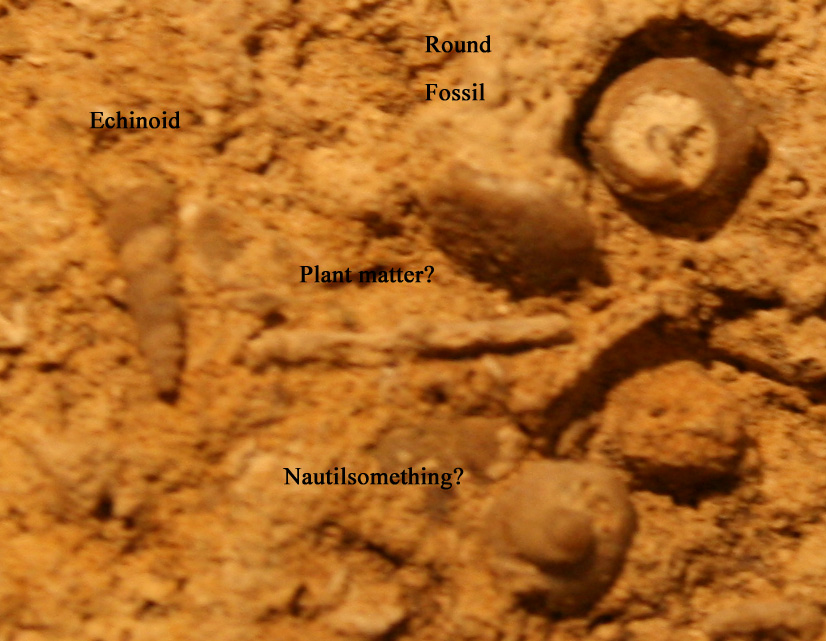
So it’s not a fossil, it’s fossils. It’s crusted with Echinoids, Crinoids, and what appear to be some flatworm things (were there segmented varieties?) round things, and what appears to be some sort of pre-nautilus critter, with soft parts partially fossilized. The photo to the right has an L-Square next to the fossil for scale, and below is a gallery of the miniature fossilized sea life coating the sandstone or limestone rock. (I’m not an expert, and could use some help here with the labels if you know what these are. Most of the external parts of this appear crusted with crinoid junk as a previous commenter noted, I found attachment points in a couple places, perhaps some plates…)
The rock around here is all carboniferous age, and the echinoids and crinoids put this in the Pennsylvanian period of the Paleozoic era, so about 323 to 290 million years old.
Here’s the gallery:
here is the fossil viewed from top down with an L square for scale
On the left you see an impression from a soft body or plant, in the center a spiral shell, and on the right an echinoid
Apologies for the lighting relics in this, upper left is an echinoid, middle appears to be plant matter, and lower right is a round fossil that I haven’t a clue about
This came out blurry so I used it to label the fossils
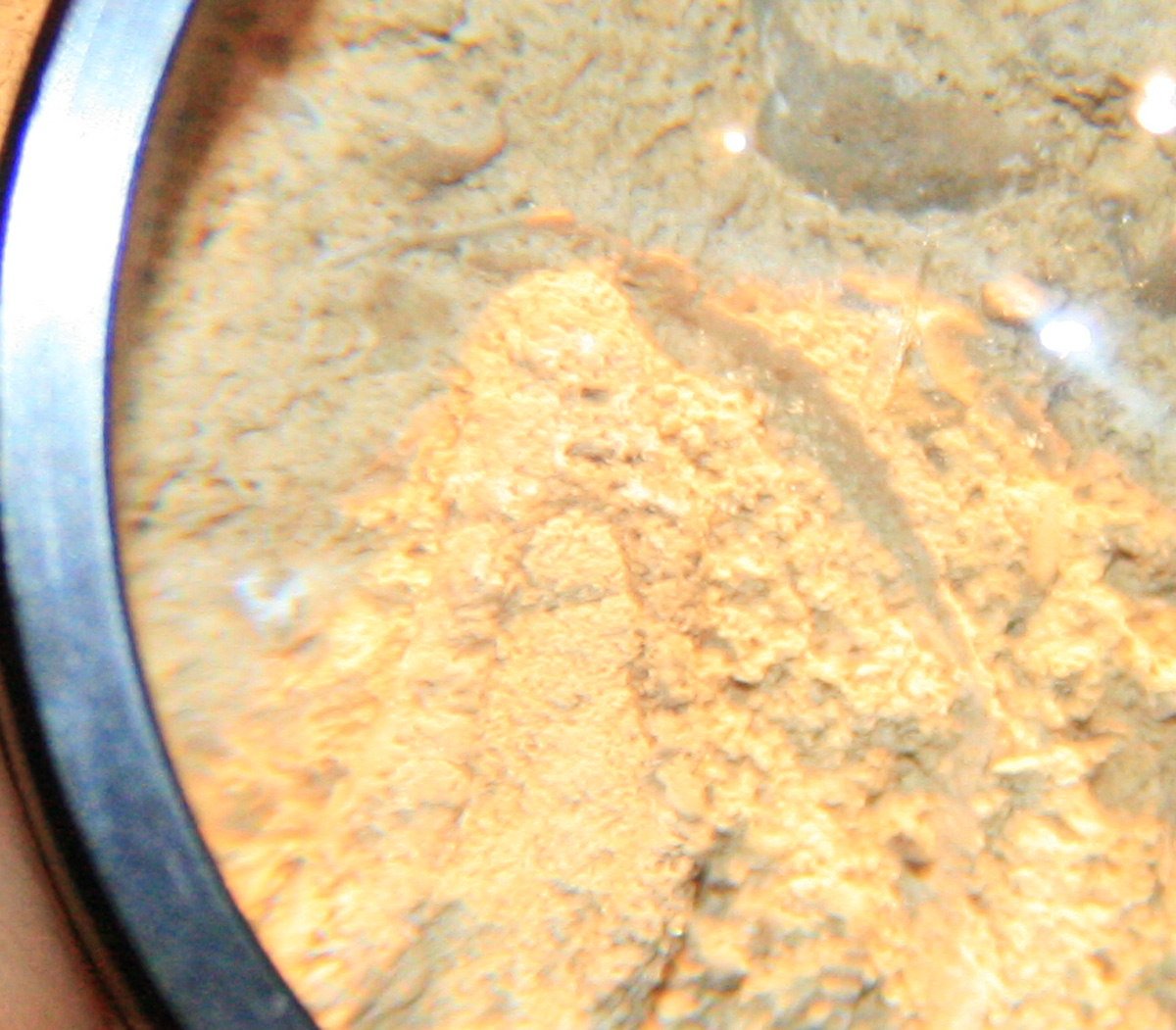
This one I’m unsure of, I can’t find it with magnifying glass, this only shows up when the photo is enlarged greatly
Appears to be a flat, or flattened worm. This wraps around an edge of the limestone or sandstone